


Roughly 80% of the world’s vanilla is sourced from Madagascar; a country prone to devastating hurricanes and flooding, and extended periods of drought and famine. It’s important for consumers and brands to ask themselves what the impact is of the vanilla they’re putting into their ice cream, coffee, and baked goods. This seemingly simple flavor has a long history of human struggle, and as a company who sources more than half a million pounds of vanilla each year, it’s imperative that we at Frontier Co-op are careful about the impact of our purchases. Moreover, we see it as our co-op’s responsibility to help our partners increase the resiliency of their businesses and their communities by investing in projects at origin.
For years, Frontier Co-op has collaborated with partners in Madagascar on a variety of impactful projects, from building and running schools to enhancing the resilience of local crops and businesses. In 2023, Frontier Co‑op partnered with Virginia Dare Madagascar to promote regenerative agroforestry practices and establish Village Savings and Loan Associations (VSLAs) to foster greater financial and environmental resilience among vanilla farming communities in northeast Madagascar.
The project is centered around two key components. The first focuses on improving food security and income diversification by supporting young farmers in implementing an integrated, regenerative agroforestry model that combines cash crops like vanilla with subsistence crops. With the backing of the Duke Lemur Center, this approach fosters long-term agricultural sustainability. The second component strengthens financial resilience within vanilla cooperatives by encouraging the adoption of Village Savings and Loans Associations (VSLAs). These self-managed lending groups, typically consisting of 10-25 members, provide inclusive and stable financial services, including savings, insurance, and credit, empowering local communities to achieve greater economic independence.
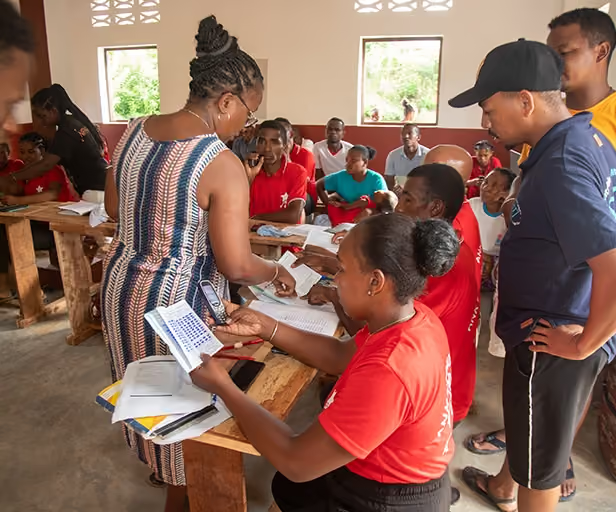
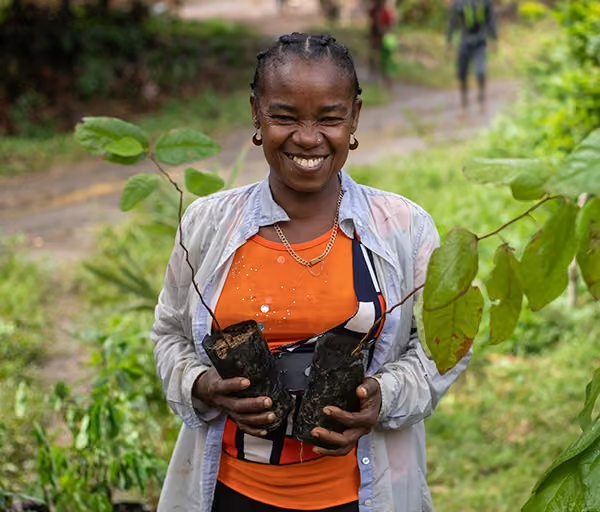
VSLAs, which are locally controlled and operate similarly to credit unions, offer a way for farmers and their families to collectively save and grow their money over time They are relatively small groups of people who pool their money together and make a series of short‑term loans to one another to invest in entrepreneurial activities that can help them financially through the annual lean periods and provide important resources for their community APPENDIX A farmer‑beneficiary of the regenerative agroforestry project smiles after receiving two saplings. A group gathers to learn more about the Village Savings and Loan Association (VSLA) model. VSLAs offer a way for communities to collectively save, invest, and grow their money locally over time. The project has been successful so far: 90 farmers are actively involved across three co‑ops, and nearly 200 farmers have attended agroforestry trainings at three demonstration plots In addition, 11 VSLAs have been created with 275 total members, approximately 80% of whom are women. We are excited to continue this important work with Virginia Dare Madagascar and other partners in the coming years.
The regenerative agroforestry model promotes crop diversification. By growing multiple types of cash crops alongside vanilla, such as cocoa, coffee, or cloves, as well as comestible staple crops like rice, corn, legumes, tomatoes, cabbage, and other vegetables, vanilla farmers can aim to raise enough food to feed their families throughout the year and can sell their excess at market in their community. Additionally, growing a diverse array of crops helps improve the ecological and microbiological biodiversity of the farm, reducing the need for soil amendments, and utilizing the complementary characteristics of each to reduce the need for chemical pesticides or insecticides, and improving overall soil health.
Because of this project, not only do growers get more pathways to incremental income but they access them in a way that improves soil health, creates habitat and increases biodiversity.